
9 systems consolidated. Refund rate cut in half.
At a glance
- Customer support, payment, and reputation data from 9 systems unified into a single BigQuery warehouse
- Cross domain dbt models that joined refund transactions to complaint data and named the root cause
- Refund rate cut in half and CSAT up across every support channel within weeks
Vero by Datum Labs built the unified data foundation for this client. GovPlus is a SaaS platform built around government services where trust is the core product. GovPlus manages customer support, payments, and public reputation across multiple channels, serving users for whom a refund or complaint carries real consequences.
Complaints were climbing. Refunds were following. The team could see both signals clearly. What they could not see was any connection between them, because the connection lived in the gap between three systems that had never been joined.
Intercom logged every conversation. Chargebee processed every payment. Google Reviews, Trustpilot, and BBB captured what customers said publicly. Each tool was doing its job. But which products were actually driving refunds? No single system could answer that. Every attempt required pulling three separate exports, cross-referencing them by hand, and hoping the timestamps lined up. By the time an answer surfaced, the refund rate had already grown.
The Problem With Fragmented Data at Scale
As complaint volume climbed, so did the cost of not knowing the answer. The team needed to see which products were generating refunds, whether CSAT was tracking with complaint patterns, and whether public review sentiment matched what was already sitting in support tickets.
None of those questions are difficult to answer once the data is connected. All of them are impossible to answer reliably when nine systems have never been joined.
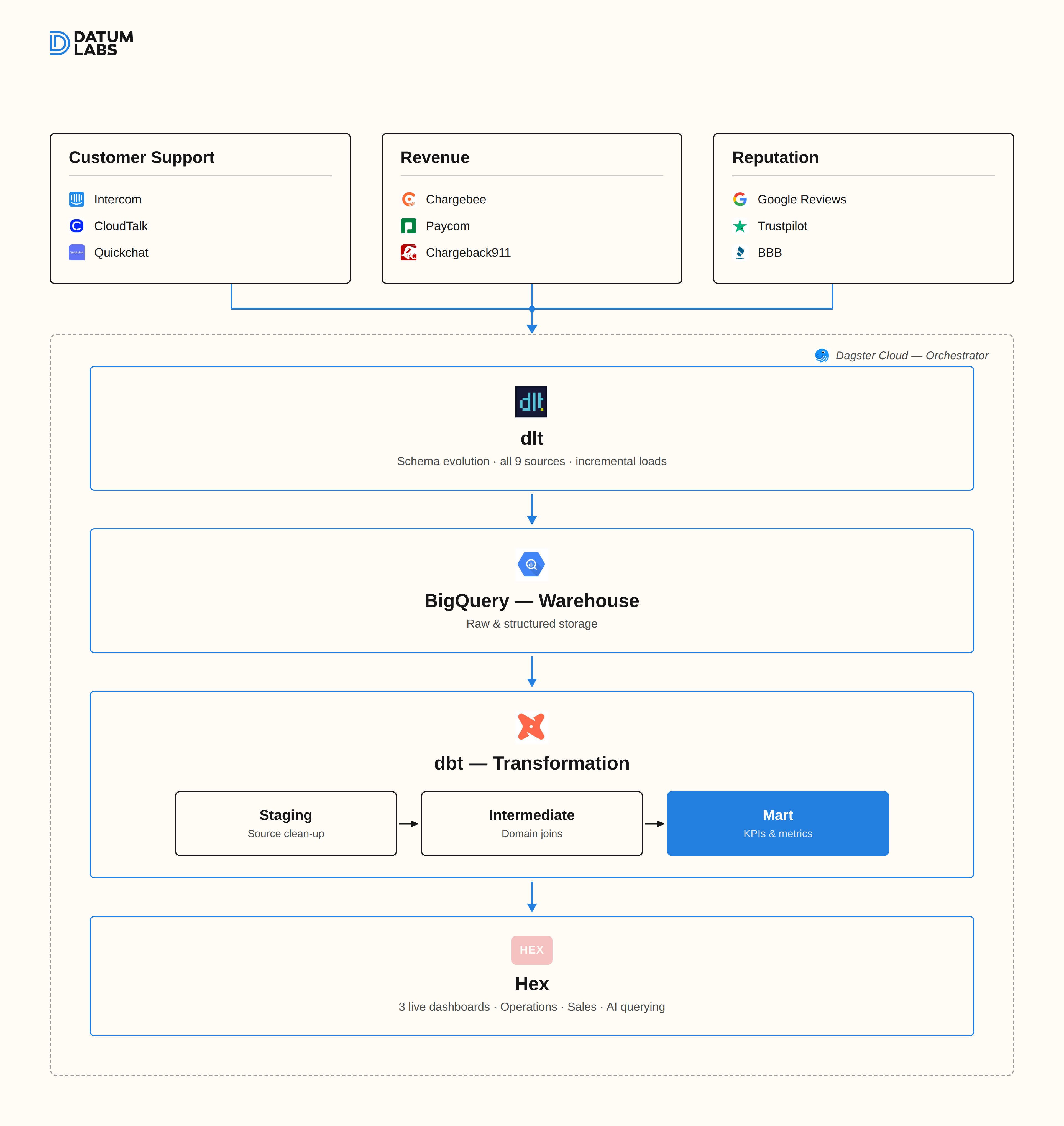
Every system GovPlus relied on, connected into one warehouse:
GovPlus was not missing data. It was missing the model that made the data mean something. Nine systems logging nine versions of the same customer story, with no layer underneath that could read all nine at once.
Why the Standard Answer Did Not Fit
Hiring a data engineer and building the connectors in-house is the obvious move. A hire also takes months to find and ramp up, costs well into six figures a year, and still only covers one layer of a nine-system stack.
GovPlus did not need a headcount. They needed a foundation built fast, owned on their own cloud, by a team that had already built this exact architecture before.
What Vero Built?
Nine sources, three domains, one warehouse. The build had a single requirement: whatever question the team asked next, the answer had to come from one place, not another round of exports.
- dlt connects all 9 sources, Intercom, CloudTalk, Quickchat, Chargebee, Paycom, Chargeback911, Google Reviews, Trustpilot, and BBB, loading them into BigQuery on a schedule
- BigQuery is the single warehouse where support, revenue, reputation, and product data live side by side
- dbt staging models clean each source independently, intermediate models join refunds to complaints to reviews, mart models surface CSAT, refund rate, and complaint-to-refund ratio by product
- Dagster Cloud keeps every pipeline running on schedule with failure alerts sent to Slack
- Hex powers three live dashboards for Operations, Sales, and Product Evaluation, with AI-assisted querying so anyone can answer a new question without filing a request
Refund rate, CSAT, complaint volume, and product-level breakdowns now come from one model. Support, revenue, and product teams no longer arrive at the same meeting with different numbers.
How the Rollout Happened?
The build followed the shape of the problem.
All 9 sources were mapped first, not just technically but relationally. How a support ticket connected to a refund transaction. How a public review connected to a product. That mapping defined what the dbt models needed to join before a single connector was written.
Ingestion came next, each source validated against its origin system before the transformation layer touched it. The cross-domain models were last and most critical: refunds joined to complaints by product, sentiment joined to support volume by channel, CSAT surfaced at the level where the team could act on it.
All 9 sources were live within days. The models that eventually named the root cause followed as each domain came online.
What Changed for the Team?
- Refund rate halved in 8 weeks once the cross domain model named the root cause products. The team fixed the cause, not the symptom
- Chat CSAT rose 7 points, with AI-handled conversations improving fastest
- Average call wait dropped from minutes to seconds once every support channel became visible in one place
- One-star reviews and BBB complaints fell to near zero as the fixes landed
Talk to the founders who scope, build, and stay, on.
The data foundation your whole team can work from — built by Datum labs.
Get in touch



Get notified when we publish. The patterns we're actually seeing across real client stacks, not theory.




.png)
.png)
.png)