
12 billing portals unified into real cost per minute
At a glance
- AI usage, cloud cost, product, support, and CRM data from 20+ systems unified into BigQuery
- A COGS model giving true cost per minute across 12 vendors and 5 cost categories
- A CSM health dashboard that flags silent and frustrated accounts before anyone has to ask
Vero, Datum Labs' data stack deployment service, built the cost and account health infrastructure for this usage-billed AI voice platform. This AI voice agent company sells call minutes to enterprise accounts across two regions, billed against infrastructure from a dozen separate vendors.
Nothing about this stack was broken. OpenAI, ElevenLabs, and Deepgram each billed cleanly through their own portal. PostHog tracked engagement, Pylon held every support thread. The problem was not any single tool. It was that pricing decisions were being made without knowing what a single minute actually cost.
The Problem With Cost and Health Spread Across 20 Systems
As the vendor stack and customer base grew, so did the difficulty of answering two questions at once: what does a call actually cost, and which accounts are at risk before the renewal conversation. CSMs managed the entire account base with no shared view of utilization, engagement, or sentiment.
Any usage-billed SaaS business eventually asks these same two questions. What this team could not do was answer them without pulling a dozen vendor CSVs by hand every single time.
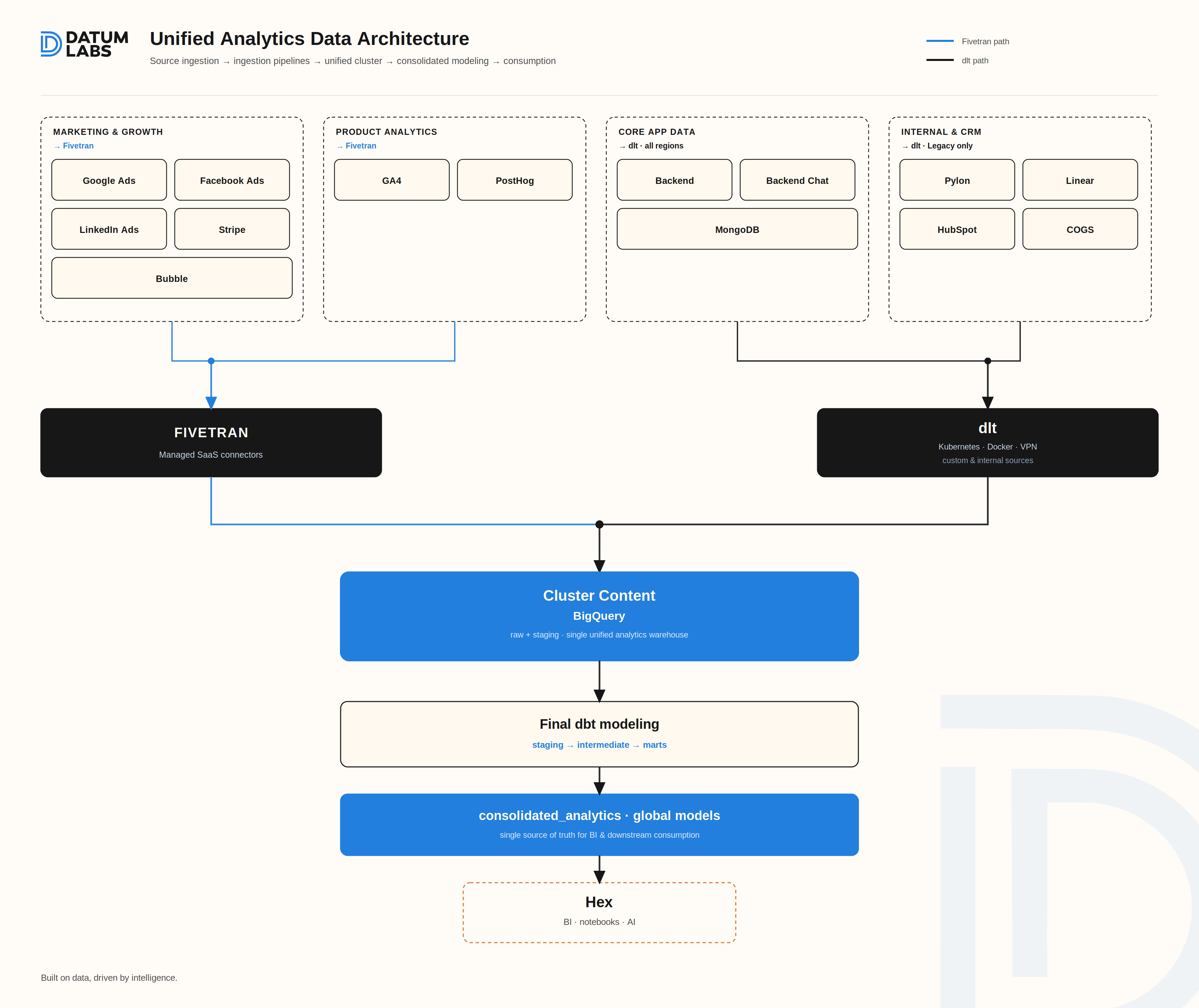
Every system the business relied on, connected into one warehouse:
The data existed. The problem was connection, and in this case, data residency. Two regions meant sensitive fields could not simply move to one server and get joined like any other warehouse build.
Why the Standard Answer Did Not Fit?
Hiring a data engineer to pull vendor bills into a spreadsheet is the obvious move. It is also the slow one. A new hire needs months to ramp up, and still has to solve in-region tokenization across US and EU alone, with no team behind them if something breaks.
This team did not need a headcount. They needed an architecture that could extract and tokenize sensitive data inside each region before anything moved, built by a team that had solved this exact problem before.
What Vero Built?
The architecture we deployed runs on one constraint: sensitive fields get tokenized inside each region before any data leaves, then everything merges into one warehouse.
- dlt connects all 20+ sources, from vendor bills to PostHog to Pylon, with schema evolution and row count checks on every run
- Dagster runs three deployments, US, EU, and legacy, handling in region tokenization before the cross region merge
- BigQuery is the single warehouse where cost, product, and CRM data live side by side
- dbt joins twelve vendor bills into true cost per minute by category, environment, and customer segment
- Hex serves a COGS dashboard for finance and a CSM health dashboard for customer success, with reverse ETL pushing updates back into Pylon and Linear
Every pricing and renewal decision now starts from a real number, not a spreadsheet estimate.
How the Rollout Happened?
The engagement moved in three stages.
- Discovery: mapped all 20+ systems across two regions, defined the cost categories that mattered, and agreed on what silent and frustrated actually mean
- Warehouse setup: in region Dagster deployments stood up in US and EU, tokenizing sensitive fields before the central merge into BigQuery
- Dashboards live: dbt models built incrementally, starting with COGS by vendor, then expanding into the CSM health cards and reverse ETL back into Pylon
What Changed for the Team?
COGS Dashboard
- Without a unified cost model, pricing decisions were guesses. Vendor bills spanned telephony, compute, and AI models, across different regions, formats, and billing cycles
- Built a pipeline that ingests every vendor bill and maps each cost to the right environment and product line
- Produces one auditable cost-per-minute figure
- That number now grounds pricing conversations, margin analysis, and board-level unit economics questions
Customer Account Health Map
- Customer data was scattered: deals in the CRM, subscriptions in the billing tool, usage in the product database
- No one had the full picture, so retention decisions ran on partial information
- Built a unified account map linking all three sources together
- For any account, the team can now see what they signed, what they're paying, and how they're using the product, in one place
- This is the foundation every customer health and ARR analysis now runs on
CSM Dashboard
- Customer success was reactive: teams learned an account was at risk only when the customer said so, or when they didn't renew
- Warning signs (usage dropping, invoices unpaid, tickets unresolved) existed but lived in different systems with nobody watching all of them together
- Pulled those signals into one live dashboard
- Replaced quarterly check-ins with a daily view of which accounts need attention and why
Enterprise Dashboard
- Enterprise accounts run large call volumes and multiple deployed agents, with usage that needs to map against contract terms
- That data lived across product, billing, and CRM with no unified view
- Built an enterprise-facing analytics layer bringing together call volume, call minutes, active agents, and usage trends
- Sales and account management conversations now run on evidence, not anecdotes, grounded in exactly what the customer is doing, how it's trending, and whether it matches their contract
Talk to the founders who scope, build, and stay, on.
The data foundation your whole team can work from — built by Datum labs.
Get in touch



Get notified when we publish. The patterns we're actually seeing across real client stacks, not theory.




.png)
.png)
.png)