

Explore AI Summary




We turn complex data into clear insights. Our comprehensive data analytics services, from strategy to execution, drive business growth and innovation.
.png)
.png)
.png)
.png)



Westwise Group runs a digital platform that connects people involved in personal injury cases with qualified law firms. It is a performance-driven business. Every pound of advertising spend is measured against lead volume and conversion rate. Marketing needs to know which campaigns generate qualified leads. Sales needs to track the full lifecycle from first contact to signed case. Finance needs spend visibility against revenue.
They had the tools to run all of this. Google Ads for paid acquisition. Zoho CRM for lead and sales management. Zoho Voice for call tracking. Zoho Books for financial data. Google Analytics for website behaviour. Five systems. Five separate environments. No layer connecting them.
The data to run the business existed. The ability to act on it as a whole, in real time, did not.
For a company where acquisition cost and conversion rate determine profitability, fragmented data is not just inconvenient. It is operationally costly.
Marketing teams could see click volume inside Google Ads but had no way to match it against conversion outcomes in Zoho CRM without a manual process. Sales had lead records but no campaign attribution to explain where those leads came from. Finance tracked spend and revenue in separate systems with no shared layer to connect them.
Answering a basic question, what is our cost per qualified lead this month, required pulling numbers from three systems, cleaning them, and combining them in a spreadsheet. That process took time and produced a figure that was already out of date by the time it was ready. And it had to be repeated every time the question was asked.
Leadership decisions moved slowly because the data did not move fast enough to support them.
The instinctive response to this kind of fragmentation is to add reporting inside each tool. Better Google Ads dashboards. More Zoho CRM views. Exporting Zoho Books data into a shared spreadsheet. These fixes are fast to implement and look like progress.
They do not work. Each tool defines its own metrics according to its own logic. A lead in Zoho CRM is not automatically the same entity as a click in Google Ads. A conversion in Google Analytics is not automatically aligned with a closed deal in CRM. No amount of configuration inside individual tools creates a shared definition across all of them.
What Westwise needed was a data layer that sat beneath all five systems, pulled from each one, and defined metrics in a single place, refreshed fast enough to match how the business actually moves. Not a better dashboard inside Zoho. A warehouse built for continuous refresh, with a governed transformation layer on top of it.
The solution was delivered through Pulse: a structured analytics foundation built to keep pace with a business that cannot afford to wait fifteen minutes for an answer, let alone a day. Pulse handles the full stack, ingestion, transformation, orchestration, and reporting, so teams engage with data rather than managing the systems that produce it.
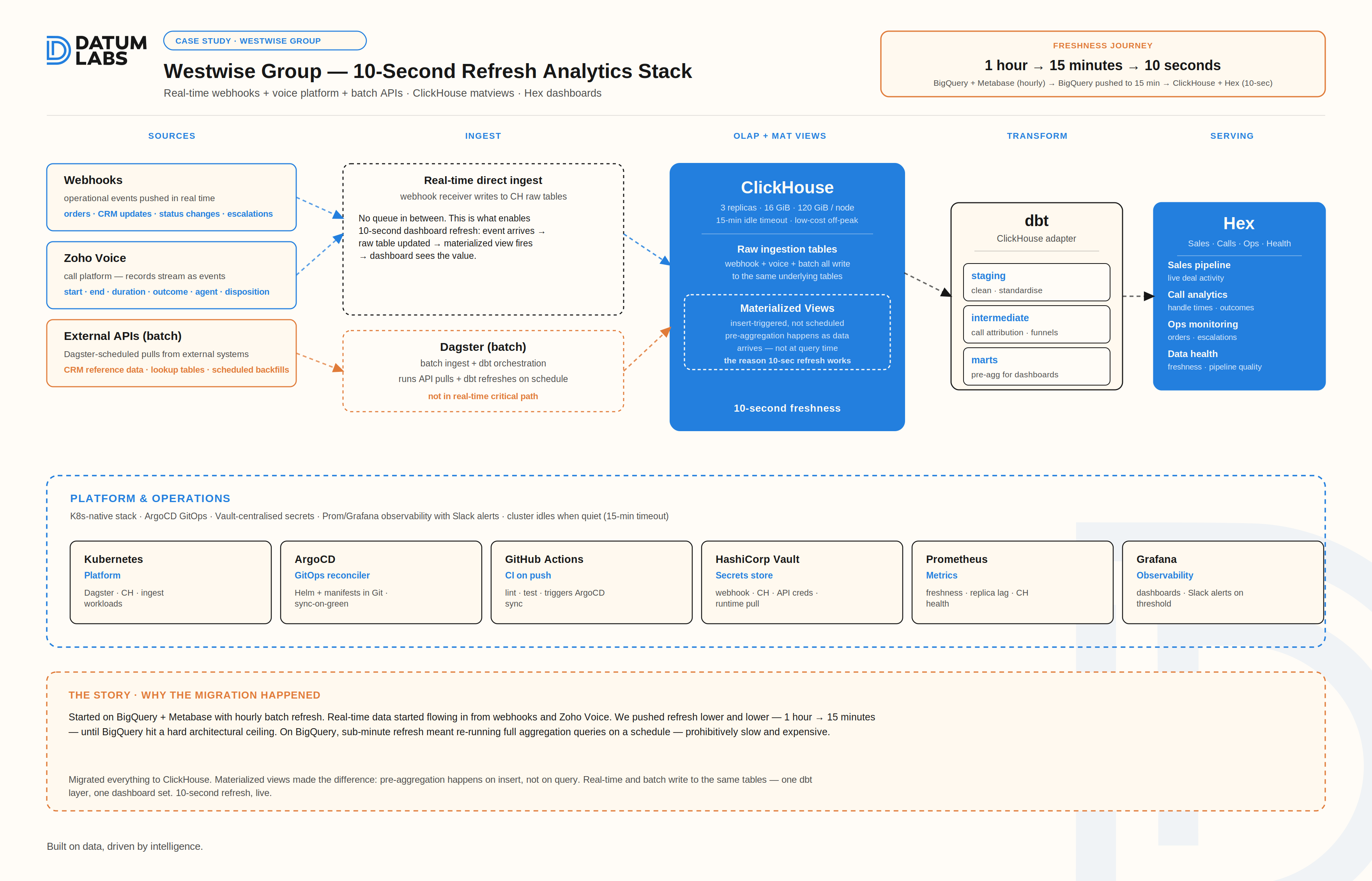
Operational events, order updates, and CRM changes get pushed the instant they happen straight into the analytics database through webhooks, no queue, no delay layer in between. Zoho Voice call records stream in the same way, so a completed call appears in reporting within seconds instead of the next day. Slower-moving reference data, like product lists and CRM pipeline stages, still gets pulled on a schedule and lands in those same tables.
Every source, real-time and scheduled, writes into the same warehouse. There is no separate real-time system and batch system to reconcile.
dbt makes the raw data usable and trustworthy. The transformation layer structures raw datasets into staging tables, intermediate models, and analytics marts. Lead attribution logic is defined once and applied consistently. A lead from Google Ads connects to its CRM outcome using the same join logic every time. Cost-per-acquisition is calculated by a model every dashboard draws from, not by individual analysts applying their own formulas.
When a metric definition needs to change, the change happens once in the dbt project and propagates to every report that references it.
The warehouse itself is built to pre-calculate the moment data lands, rather than recalculating every time someone opens a dashboard. That shift, not a faster query engine, is what took the refresh time from fifteen minutes down to ten seconds. Running on three separate machines means one node going down never takes dashboards with it.
Dagster orchestrates the scheduled side of the pipeline, batch pulls and dbt runs, and surfaces failures before they affect reporting. If an ingestion run fails, the team knows immediately, not when someone notices a dashboard has stopped updating.
Hex connects to the warehouse and provides the reporting surface, refreshed every ten seconds. Dashboards cover marketing performance, sales conversion, and operational metrics. Teams across the business can explore insights and answer questions without writing queries or waiting for a data pull from engineering.
Westwise started on an hourly refresh with their original warehouse. That was pushed down to fifteen minutes, and that became the ceiling, going faster on that architecture meant re-running full calculations every few seconds, which gets expensive fast and eventually becomes impossible, not just costly.
The migration ran the new warehouse in parallel with the old one, validating every model until output matched exactly. Nothing was switched off until the numbers agreed.
The full platform was live and in daily use within a few weeks of the engagement starting.
The before and after is measurable in how the business makes decisions.
Before, the answer to most cross-platform questions arrived minutes to hours late and required manual assembly. After the platform was live, the same questions are answered by dashboards that update automatically every ten seconds.
Nobody on the team manages infrastructure or assembles spreadsheets to answer business questions. The data layer runs automatically, refreshes continuously, and produces consistent numbers every time.
This is what Pulse is built to deliver: a governed, reliable analytics foundation for businesses where data quality and reporting speed directly affect commercial outcomes. Westwise now operates on that foundation.
If your marketing and sales data lives across disconnected platforms and the full picture only comes together minutes or hours late, the gap between your data and your decisions will not close on its own.


Explore AI Summary
We turn complex data into clear insights. Our comprehensive data analytics services, from strategy to execution, drive business growth and innovation.

