

Explore AI Summary




We turn complex data into clear insights. Our comprehensive data analytics services, from strategy to execution, drive business growth and innovation.
.png)
.png)
.png)
.png)



Venon is an ad analytics and e-commerce platform. At its core, the product tracks how advertising spend translates into shop revenue impressions, clicks, visits, orders, refunds across multiple ad accounts and storefronts simultaneously. For a platform where the core value is performance visibility, the data layer is not a back-office concern. It is the product.
The production database handled the application workload well. It was not designed to also answer analytical queries. Running complex analysis directly against a live transactional system creates read pressure that competes with application traffic and makes query performance unpredictable at scale. The engineering team knew this. What they needed was an analytical layer that matched the seriousness of the product they were building.
Venon had already tried a simpler path. The original analytics stack ran on Docker Compose, a reasonable starting point that quickly revealed its limits in production. Every deployment was manual. Every schema change carried risk. When something broke, finding out why meant digging through logs on a single machine with no structured observability.
The specific issues that made the setup unsustainable:
The team was not looking for a faster pipeline. They were looking for a foundation they could trust, extend, and hand off without anxiety.
The architecture Datum Labs designed and now operates for Venon starts from the production database and ends at the analytics surface, with every layer observable and every change traceable.
Change data capture reads the database write-ahead log continuously. Every insert, update, and delete in the production system becomes a structured event that travels through Kafka, a durable message stream that acts as a buffer between the source and the analytical layer. If ClickHouse is temporarily unavailable, events queue in Kafka and drain when it recovers. Nothing is lost.
ClickHouse receives the event stream and maintains 27 raw tables that mirror the production database in real time. On top of those, a structured transformation layer processes raw change data into business-ready models, cleaning column names, applying revenue logic, resolving refund attribution, and computing funnel steps. Mart tables serve as the stable interface that dashboards and APIs query. They refresh every five minutes.
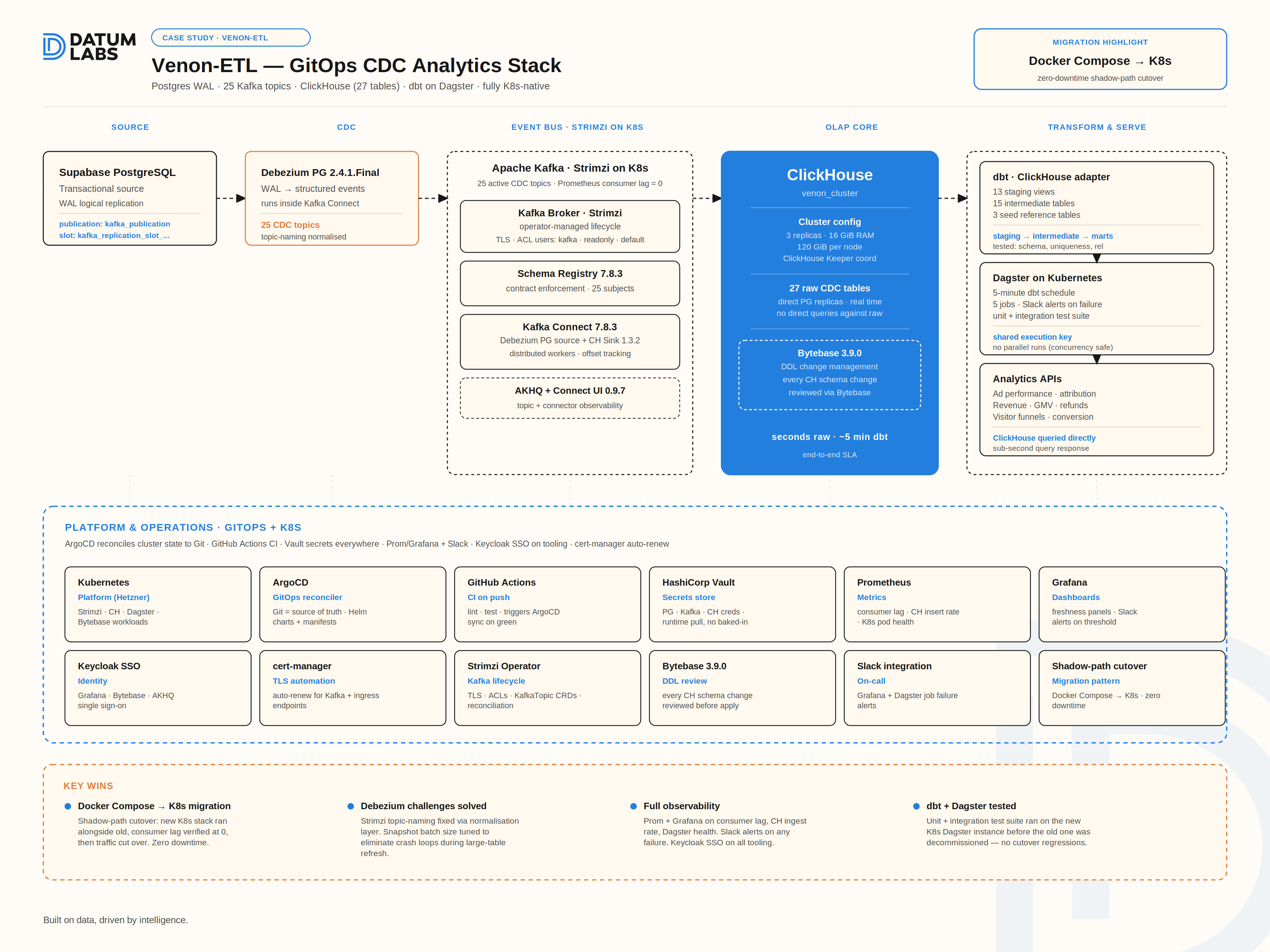
What makes this different from a fast data pipeline is the discipline applied to every layer around it. Schema contracts enforced at the stream level prevent upstream changes from silently corrupting downstream tables. Every ClickHouse schema change goes through a reviewed workflow before it is applied. Slack alerts fire on any pipeline failure with enough context to diagnose the issue without opening a terminal.
Migrating a production pipeline without disruption is where most data projects fail quietly. The Venon migration ran in parallel, the new Kubernetes-based stack processed live data alongside the existing setup, and parity was validated before any traffic was cut over.
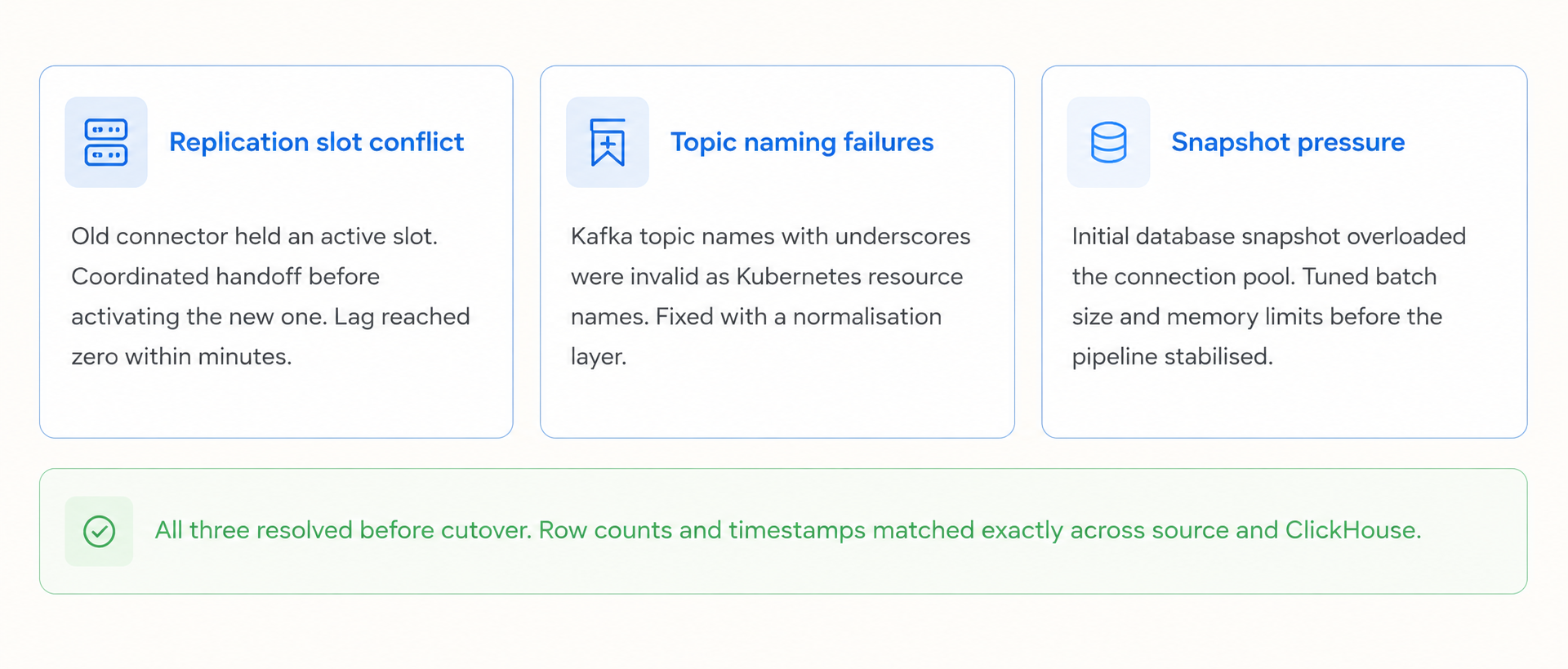
The migration surfaced real challenges:
Each of these was resolved before the cutover. Consumer lag reached zero within minutes of the final switch. Row counts and timestamps matched exactly across source and destination.
The Venon stack runs entirely on Kubernetes. Every component, the change capture connector, Kafka, ClickHouse, the transformation layer, the orchestration engine is defined in code and lives in version control. Deployments are automatic on merge. Rollbacks are reverts.
The result for the analytics surface:
The observability layer monitors every layer continuously. Kafka consumer lag, ClickHouse insert throughput, transformation job success rates, and infrastructure health are all visible in a single monitoring surface. If a table has not updated within its expected window, an alert fires before any user notices.
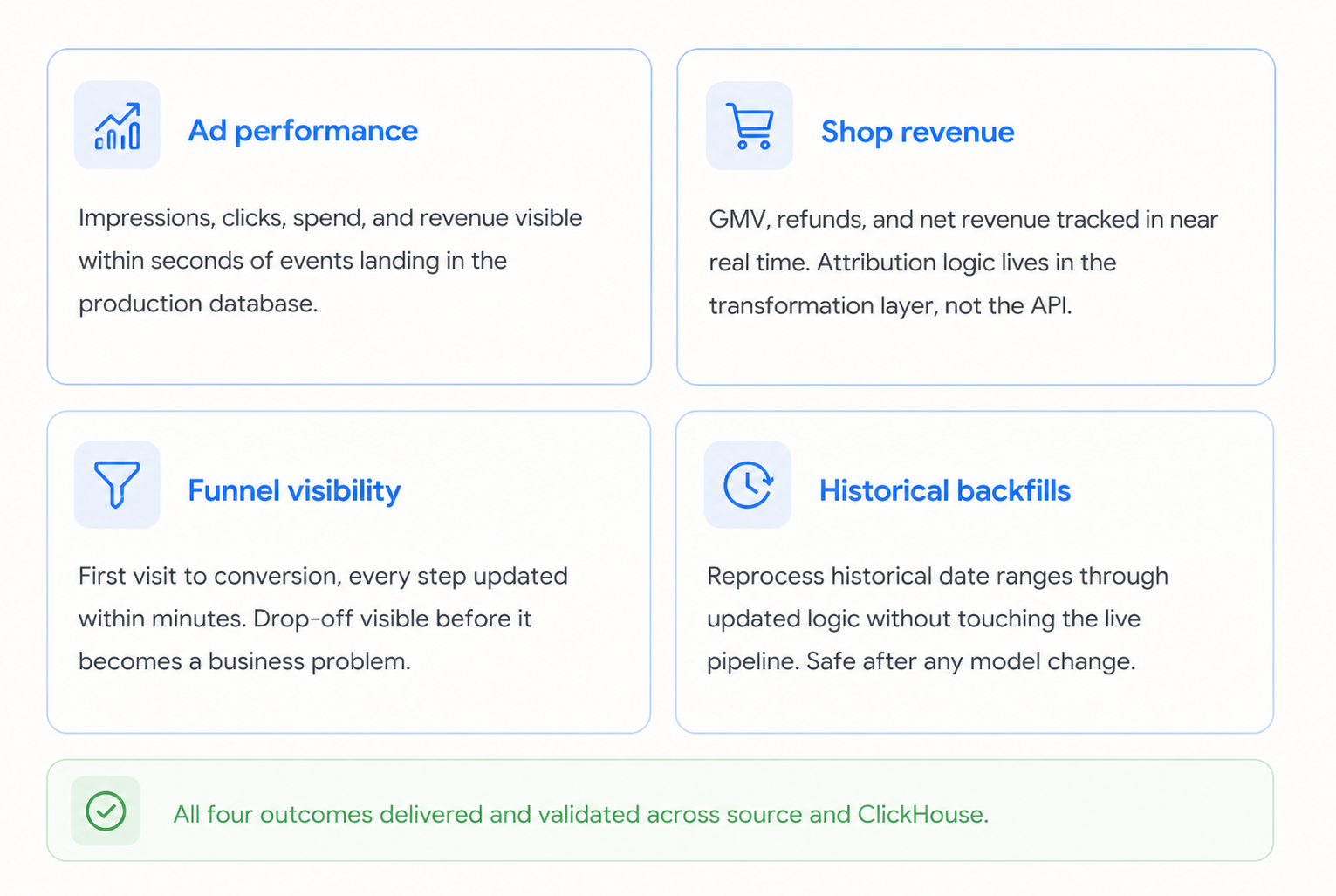
Adding a new data source today means a new change capture topic, a new staging model, and a pull request. No re-architecture. No downtime. No surprises.
The pipeline Venon runs is not remarkable because it is fast. It is remarkable because it was built to be trustworthy and every decision in the architecture reflects that.


Explore AI Summary
We turn complex data into clear insights. Our comprehensive data analytics services, from strategy to execution, drive business growth and innovation.

