

Explore AI Summary




We turn complex data into clear insights. Our comprehensive data analytics services, from strategy to execution, drive business growth and innovation.
.png)
.png)
.png)
.png)



YourStage.live is a streaming and live events platform serving content creators, festival organizers, and their audiences. In the creator economy, the link between content performance and creator earnings is direct and operationally unforgiving. Viewing sessions drive revenue calculations. Revenue calculations drive invoices. Invoices drive payouts. Every step depends on accurate, reconciled data flowing correctly from the system before it.
Uscreen handled session and sales events. Stripe managed payments. Bexio handled invoicing. Each system did its job in isolation. What was missing was the platform that connected them into one coherent operational layer.
Platforms in this space run on a promise: you create content, we track the performance, and you get paid what you're owed. When the data layer behind that promise is fragmented, the trust breaks first. Creators who can't see their own earnings start questioning whether the numbers are right. Festival organizers without event-level visibility can't evaluate performance or plan the next one. And the platform absorbs the overhead of manually reconciling what should have been automatic from the start.
The streaming and payment data was flowing. The operational system on top of it wasn't.
The instinctive fix is to hire a developer, wire up the webhook feeds, and write a reconciliation script that runs before payout day. That holds up until the platform grows. At scale, manual reconciliation means every payout cycle carries the risk of a calculation error, a missed session, or an invoice that doesn't match what actually happened.
YourStage.live didn't need a script. They needed an operational backend with real ingestion, a calculation engine, a governed data layer, and creator-facing APIs, built by a team that had What Orbit built
The architecture runs on one constraint: every viewing event in Uscreen becomes a governed financial record that flows through to an invoice and a payout automatically, with nobody touching it in between.
Every payout now traces directly back to a session record. No gap. No manual step.
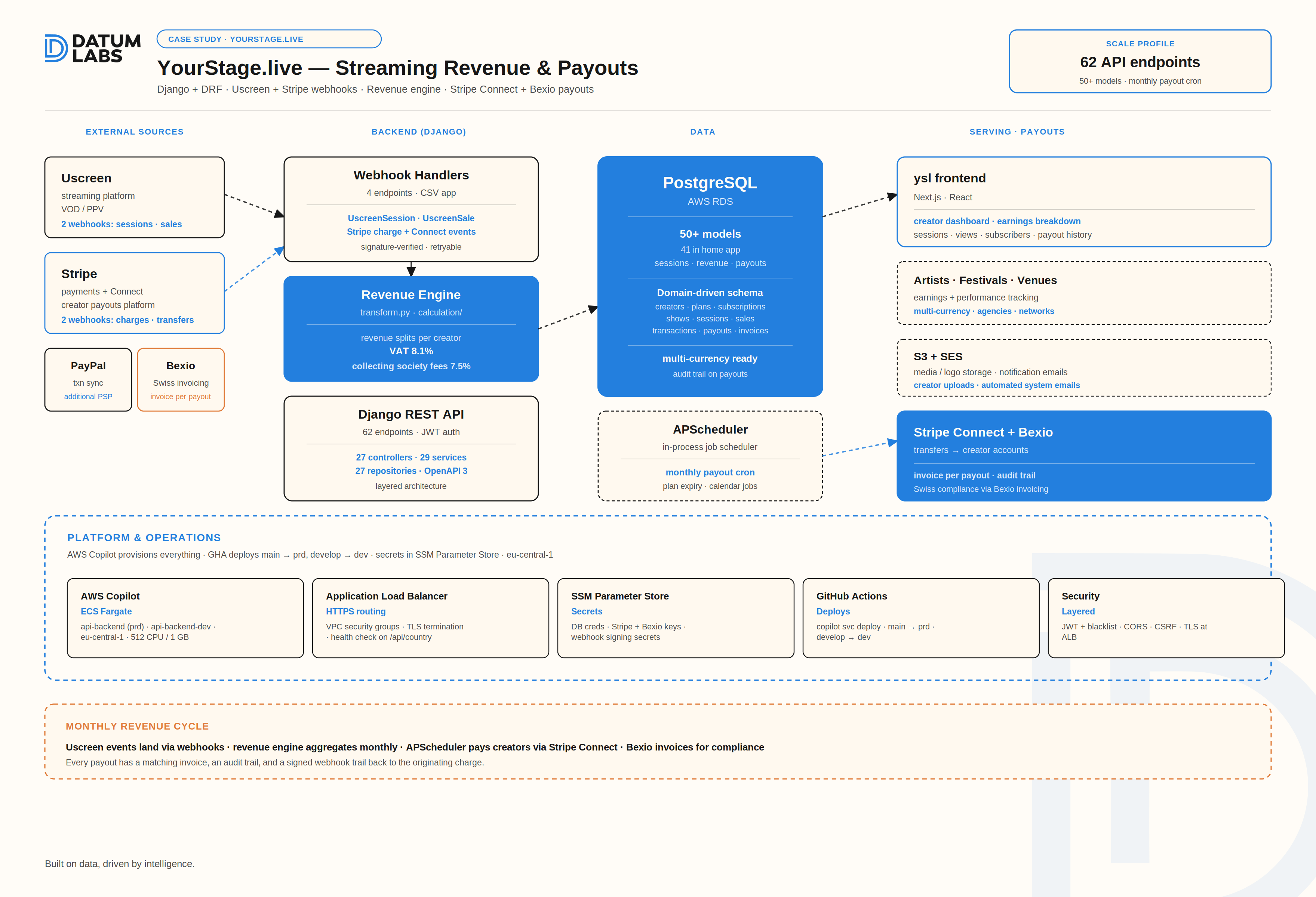
Every raw session and sales row from Uscreen was validated against the actual webhook payload before any revenue calculation touched it. The numbers were trustworthy before they were ever used, not after.
Sessions, sales, revenue, payouts, and plans all live in the same governed PostgreSQL layer, with raw source data kept intact. Recalculating a payout never means guessing, it means re-running against the same trusted records.
Stripe and Stripe Connect fire off actual revenue records instead of a manual trigger. Bexio syncs customer records and generates invoices on its own. Nobody has to remember to run anything.
Creators get earnings and payout summaries scoped to them. Festival organizers get event-level visibility scoped to their events. Nobody's looking at someone else's numbers, and nobody's waiting on someone else to pull a report.
Before, revenue reconciliation required manual coordination at every payout cycle. Creators couldn't reliably see their own earnings between payouts. Festival organizers had no visibility into event-level performance. The internal team held three systems together by hand.
The data was always there. Orbit built the operational system that made it usable for every user type the platform serves.


Explore AI Summary
We turn complex data into clear insights. Our comprehensive data analytics services, from strategy to execution, drive business growth and innovation.

