

Explore AI Summary




We turn complex data into clear insights. Our comprehensive data analytics services, from strategy to execution, drive business growth and innovation.
.png)
.png)
.png)
.png)



Techsource manages vendor relationships, software contracts, and spend across multiple departments. As the portfolio grew, so did the difficulty of tracking what was active, what was expiring, and what it all cost. The data existed. Contracts were recorded. Transactions were logged. But no interface connected those records to the people responsible for acting on them.
Finance assembled spend summaries by hand. Operations chased renewal deadlines through calendar reminders and email threads. Department leads had no direct visibility into their own vendor activity. The bigger the portfolio grew, the more coordination it took to answer basic questions.
Organizations managing large vendor portfolios hit the same wall. Contracts accumulate across procurement tools, spreadsheets, and renewal calendars. Spend data lives in finance systems. Department ownership sits somewhere else entirely. None of it is built to answer the question operations and finance ask most: what do we have, what does it cost, what's expiring, and who owns it?
For Techsource, the data existed. What was missing was a working interface connecting it to the people responsible for acting on it. At scale, that's not an inconvenience; it's a financial risk: missed renewal windows, untracked spend growth, and no department-level visibility.
Contract and transaction records lived in a backend system, accessible only to whoever maintained it. No department lead could pull their own spend view. No structured process existed for requesting a new contract or flagging a cancellation. No automatic signal fired when a renewal window was closing in.
There was no governed access model either. Sensitive spend data, vendor terms, and contract metadata were either locked away entirely or exposed without meaningful role separation. The gap between the data and the people who needed it wasn't a feature gap. It was structural.
Every system Techsource relied on connected into one portal:
The instinctive fix is a shared spreadsheet, a renewal calendar, and a request to finance for spend reports as needed. That works for a small portfolio. At scale, it becomes the bottleneck: every question needs a person in the middle, and every renewal depends on someone remembering to check.
Techsource didn't need better spreadsheets. They needed a production application layer with role-scoped access, structured workflows, and automated reminders, built on top of their actual contract data by a team that had designed this kind of operational portal before.
The architecture runs on one constraint: every user sees exactly what they're responsible for, and every action they need is available directly in the interface, no report request, no chasing someone over email.
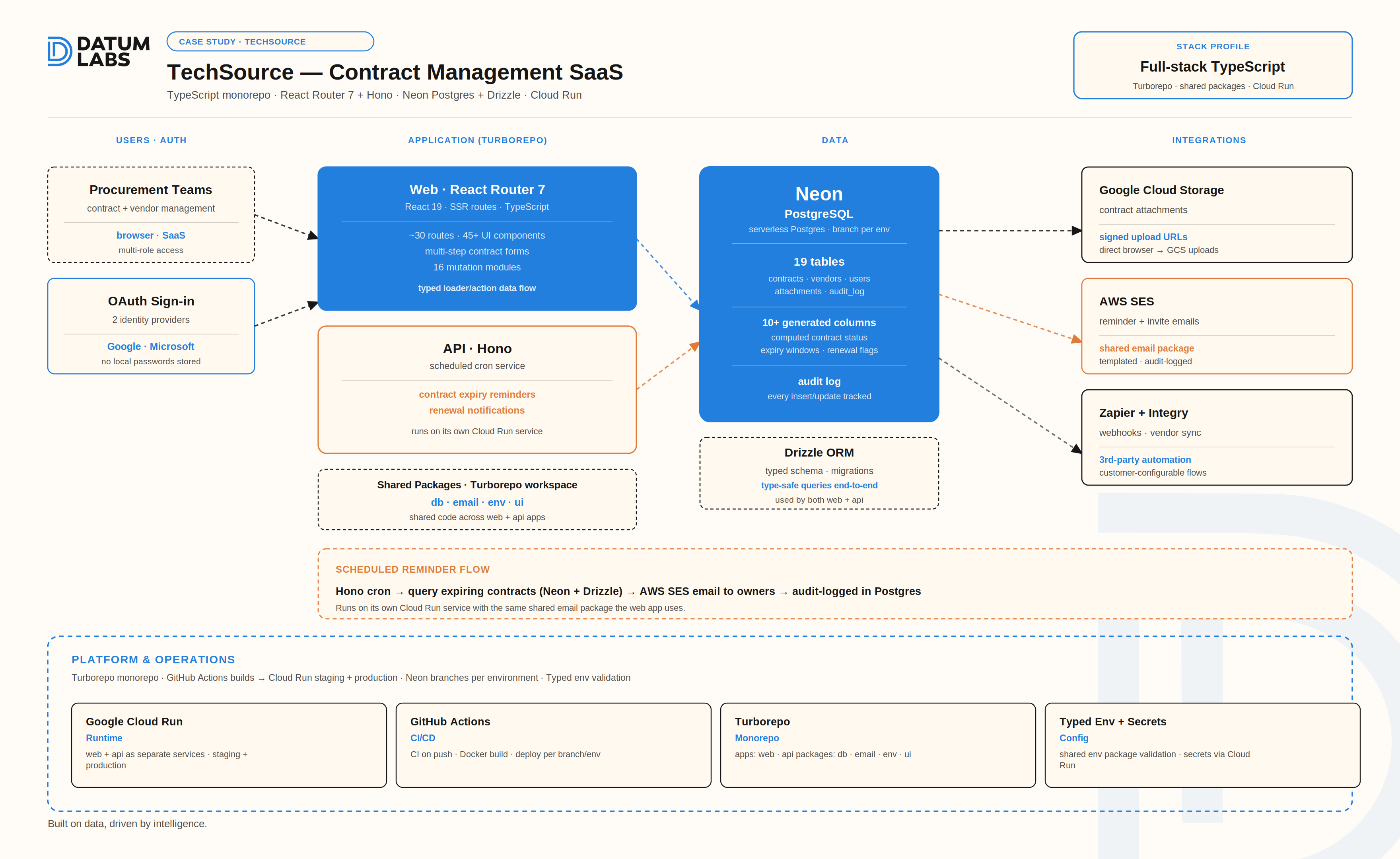
The full contract and spend data model got mapped before any screen was designed. Role-scoped access was defined across finance, operations, and department leads, and every workflow type the portal needed to handle was agreed upfront.
PostgreSQL with Drizzle ORM and Zod schemas, structured around organizations, users, memberships, departments, vendors, contracts, reminders, attachments, comments, transactions, and auth sessions, with multi-tenancy built into the access model from day one.
Google OIDC and Microsoft OIDC for authentication, Zapier webhooks and the Integry marketplace for workflow connections, AWS SES and Google Cloud Storage for delivery and file handling.
The organization dashboard, insights workspace, renewals workspace, admin modules, and workflow request forms went live, scoped correctly for every user role from the first login.
Before, contract intelligence required manual assembly at every step. Finance requested exports. Operations kept a separate renewal calendar. Department leads had no direct visibility at all.
The data was always there. Orbit built the layer that made it usable for every team that needed it.


Explore AI Summary
We turn complex data into clear insights. Our comprehensive data analytics services, from strategy to execution, drive business growth and innovation.

