

Ask AI for a summary about Datum Labs




We turn complex data into clear insights. Our comprehensive data analytics services, from strategy to execution, drive business growth and innovation.
.png)
.png)
.png)
.png)



Unscreen handled session and sales events. Stripe managed payments. Bexio handled invoicing. Each system worked in isolation. What was missing was the backend platform that connected them into a coherent operational layer: one that ingested streaming data, calculated partner revenue share, exposed creator-facing dashboards, and executed billing and payout workflows automatically.
Platforms in the creator economy operate on a promise: you create content, we track the performance, and you get paid what you are owed. When the data layer behind that promise is fragmented, the trust breaks down. Creators who cannot see their own earnings begin to question the accuracy of what they are being paid. Festival organizers without event-level visibility cannot evaluate performance or plan future activations. The platform itself absorbs the operational overhead of manually reconciling what should be automated.
YourStage.live understood this. The streaming and payment data was flowing. The operational system on top of it was not.
Uscreen provided session and sales event data. Stripe handled payments. Bexio managed invoicing. Each system did its job. What was missing was the layer in between: a backend that could ingest those event streams, calculate partner revenue share accurately, expose that data through dashboard APIs, generate invoices, trigger payouts, and manage production scheduling against purchased plan capacity.
Without that application layer, creators could not see their own earnings reliably. Revenue reconciliation required manual intervention. Payout execution depended on operational coordination at every step. The platform had data but not a working system on top of it.
Datum Labs designed and built the backend platform that connects Uscreen activity data through to creator dashboards, reconciled revenue records, invoice generation, and payout execution.
Webhook-driven ingestion pipelines receive Uscreen session and sales data, store raw rows, and run calculation logic to derive clean session, stream, dashboard, PPV, bundle, and revenue records. A revenue calculation engine covers PPV, bundle, and subscription models, with results linked to invoice records and surfaced through authenticated API endpoints.
The creator-facing dashboard exposes revenue summaries, payout summaries, view counts, top-performing streams, top regions, and time series charts. Payment and billing workflows use Stripe for card payments and Stripe Connect for creator payouts. Bexio handles customer records and invoice synchronization. A recurring scheduler tracks production and live event usage against purchased plan capacity. Festival organizers have scoped visibility into event-level performance through direct data mappings.
The data layer runs on PostgreSQL. Raw and processed tables cover normalized viewing sessions, Uscreen raw sessions, sales records, PPV aggregates, dashboard aggregates, stream records, revenue records, payouts, plans, and scheduler data. Uscreen sends webhook payloads and the backend stores raw rows before processing code derives clean analytical records, keeping source data intact and recalculation possible.
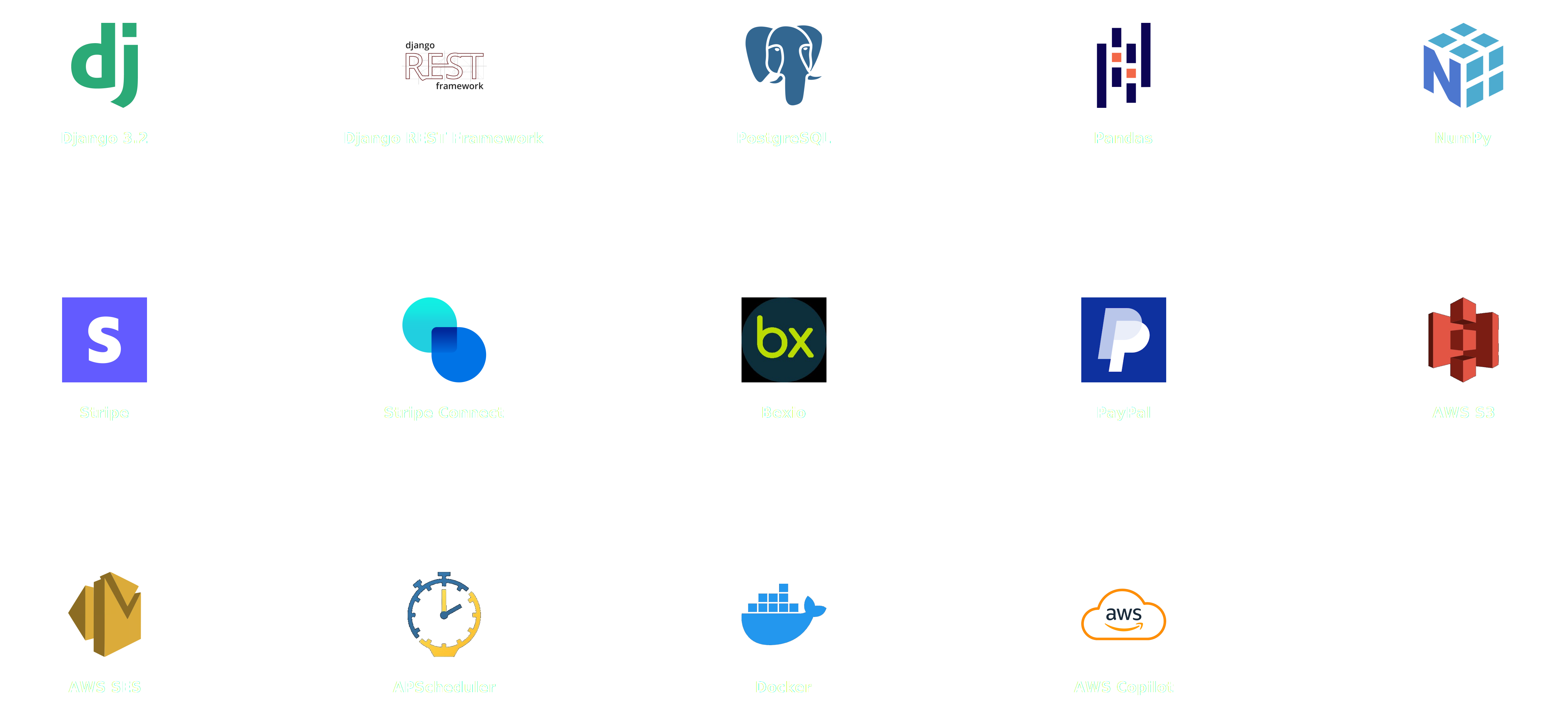
Bexio and Stripe handle billing and payouts. AWS SES handles transactional email. AWS S3 manages file storage. APScheduler runs recurring jobs. The platform is containerized with Docker and deployed via AWS Copilot. The architecture was designed around the operational reality of creator revenue: data arrives continuously as events, needs to be reconciled before it becomes financially meaningful, and must be presented differently to creators, organizers, and administrators.
Creators gained a dashboard that accurately reflects their earnings from streaming activity. Revenue reconciliation moved from a manual process to an automated calculation pipeline. Invoice generation and payout execution became connected to actual revenue records rather than dependent on operational coordination. Festival organizers gained scoped visibility into event-level performance. The internal admin team gained a governed interface for managing the full platform.
The underlying data was always there. What Datum Labs built was the operational system that made it usable for every user type the platform serves.
If your platform generates business data but your users, partners, or teams still cannot access it directly, the problem is the application layer sitting between the data and the people who need it.


Ask AI for a summary about Datum Labs
We turn complex data into clear insights. Our comprehensive data analytics services, from strategy to execution, drive business growth and innovation.

